Egypt’s Automotive Industry Faces 4 Key Challenges to Become a Regional Hub
The Egyptian government is advancing an ambitious plan to strengthen Egypt’s automotive industry and position the country as a regional manufacturing and export hub under Egypt Vision 2030.
The strategy aims to increase annual production from around 95,000 vehicles to 500,000 units, with a quarter allocated for export, potentially generating up to $4 billion annually.
While Egypt’s automotive industry holds significant growth potential, experts highlight structural challenges that must be addressed to achieve these targets, particularly amid strong regional competition and global industry shifts.
Boosting Local Content
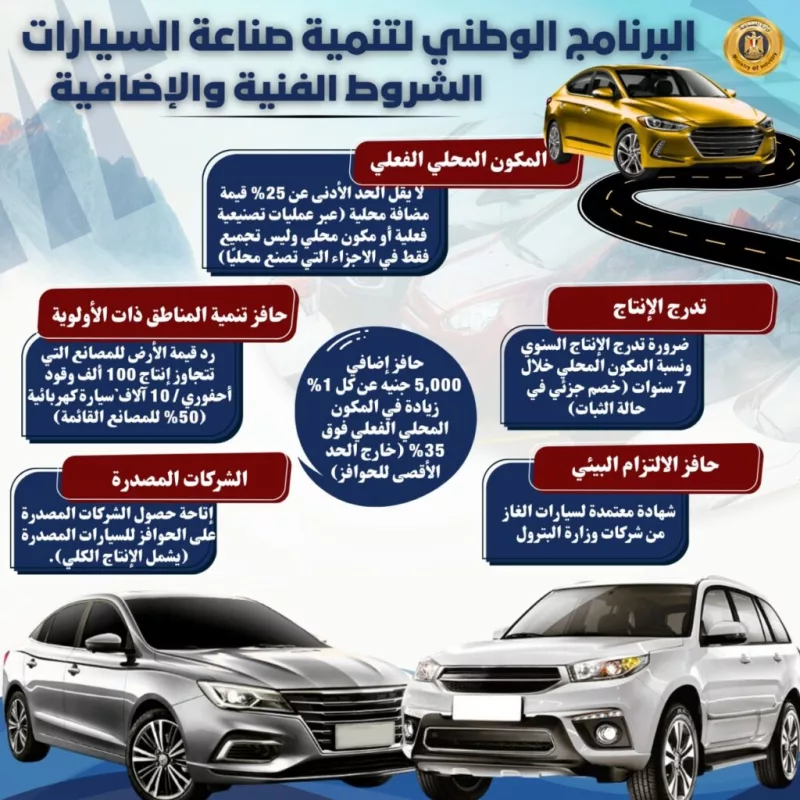
The strategy seeks to raise the local content ratio to 60% by supporting feeder industries and encouraging global manufacturers to establish production facilities in Egypt.
Strengthening domestic supply chains is considered essential for advancing Egypt’s automotive industry and reducing reliance on imports.
Government incentives require a minimum annual production of 10,000 conventional vehicles and 1,000 electric vehicles, with additional financial rewards for companies exceeding a 35% local content threshold.
Heavy Dependence on Imports
Nearly 90% of vehicle components are imported, exposing manufacturers to exchange rate volatility and supply chain disruptions.
This dependence directly impacts production costs and the stability of Egypt’s automotive industry.
Experts argue that attracting foreign direct investment to localize spare parts manufacturing is crucial to ensure sustainability and enhance export competitiveness.
Regional Competition
Another key challenge stems from neighboring countries offering attractive tax and customs incentives to global carmakers.
Some regional competitors have successfully scaled annual production to nearly one million vehicles.
Enhancing Egypt’s automotive industry requires benchmarking local incentives against successful regional models to create a competitive investment climate.
Skilled Workforce Gap
The transition toward electric and advanced vehicles highlights the need for a specialized workforce.
Expanding automotive engineering programs and technical schools is vital to support Egypt’s automotive industry in adapting to modern technologies.
Industry specialists emphasize that investing in human capital is fundamental to ensuring long-term growth and innovation.
Supporting SMEs and Feeder Industries
The fourth challenge involves providing financial and tax incentives to small and medium-sized enterprises to integrate them into automotive supply chains.
Strengthening local feeder industries can reduce imports, create jobs, and increase the industrial sector’s contribution to GDP, reinforcing sustainable economic development goals.